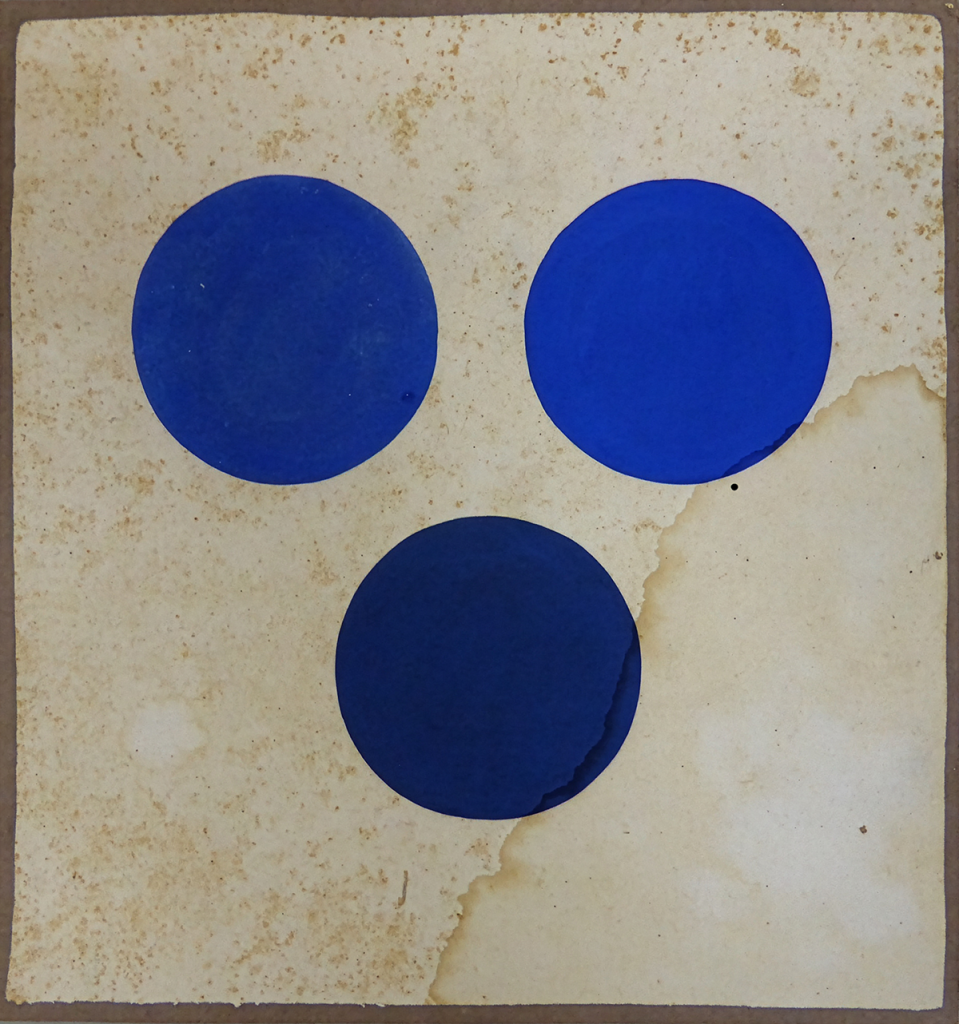
In Praise of the Line (Éloge du trait) draws its inspiration from Henri Michaux‘s Aventures de lignes (1954), in which the author celebrates the line as a primary, pure, and immediate gesture. For Henri Michaux, drawing is above all an internal act: the line springs from impulse, preceding language, without a project of representation. Each line thus becomes the direct expression of a vital movement, of energy in tension, of a breath passing through the hand. The point, the line, and the plane are no longer mere formal elements, but active forces, capable of structuring the visible and offering a glimpse of the invisible. The work follows this lineage, highlighting drawing as an autonomous, intimate, and poetic gesture, where action precedes the image and the trace reveals the artist’s inner state.
Through a selection of works from the agnès b. collection, the journey unfolds in a space where the gaze confronts the fundamental structures of perception. The exhibition questions the line’s capacity to articulate emptiness, to delimit space, and to produce an architecture of the sensible. From the gesture traced on paper to the surface inhabited by matter, geometric rigor dialogues with organic momentum, revealing how these elementary forms become vectors of raw expression.
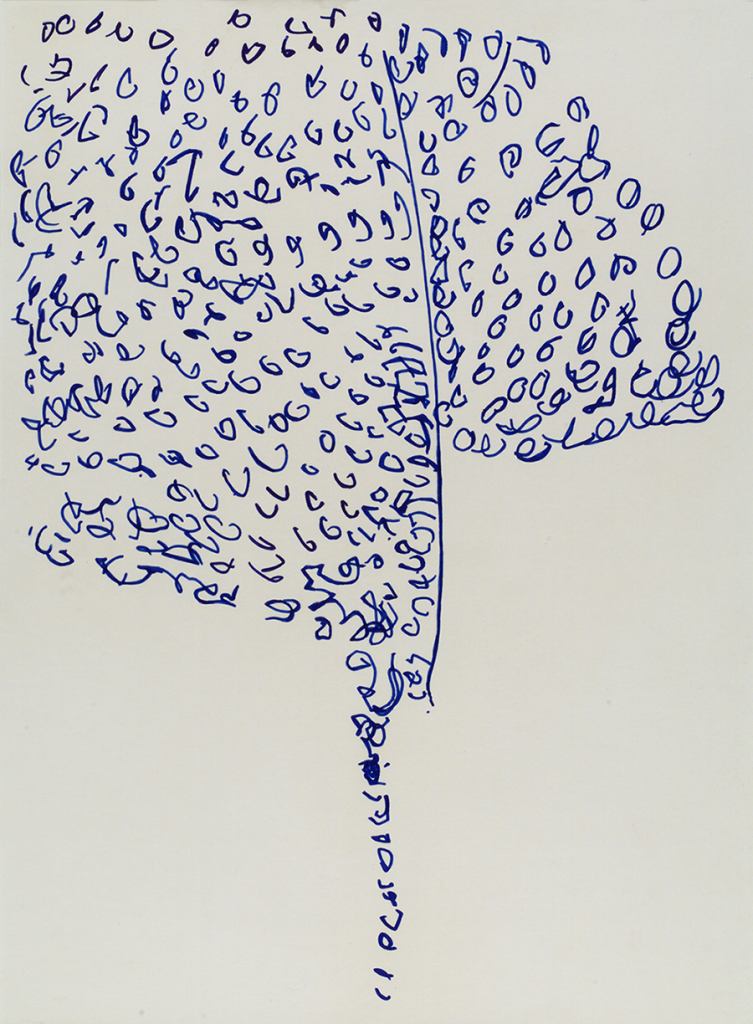
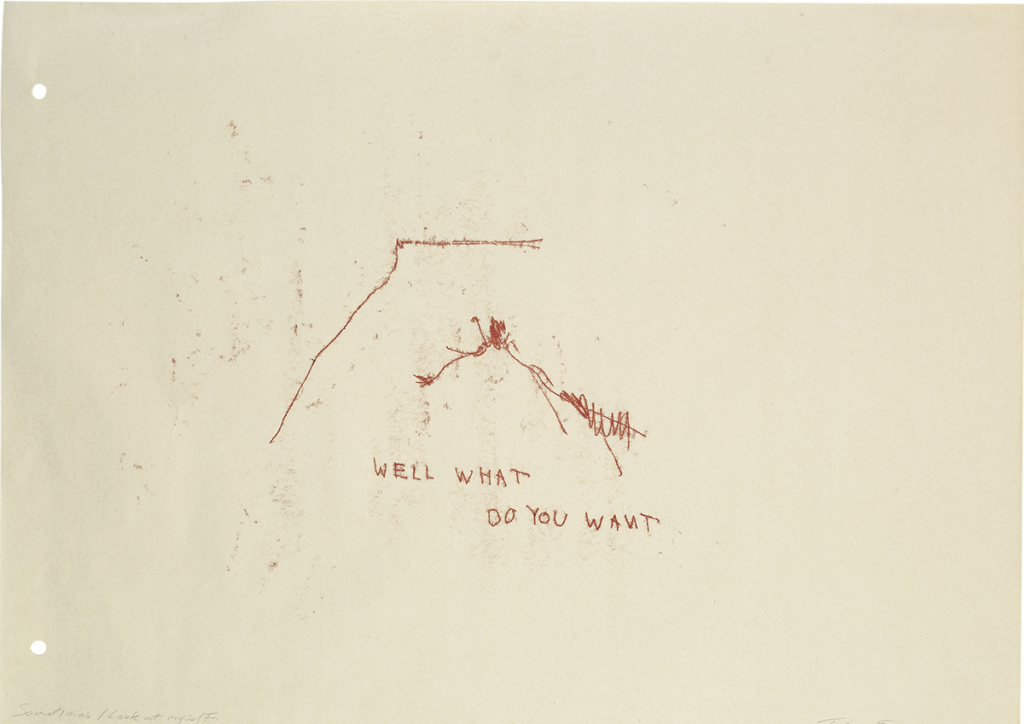
The line first asserts itself as a measure of time and effort. In Cyprien Chabert’s work, obsessive repetitions in ink draw a cartography of the gesture. They find an echo in the nervous writings of Tracey Emin, where the red line becomes the receptacle of an immediate confession. Linearity then leaves the plane to inhabit volume: with Alexander Calder, the line draws in the void; in Didier Marcel’s work, twisted rebar transforms an industrial material into an organic silhouette standing in space.
Structural rigor becomes radicalized with Donald Judd, whose anodized aluminum volumes assert the plane as an autonomous presence. This geometry is answered by the photography of Lucien Hervé, which carves out planes of light and shadow to reveal the invisible skeleton of reality through the architecture of Brasilia or UNESCO.
The point becomes an existential unit of account for Jonathan Borofsky, marking the passage of time through numbers, while Louise Bourgeois makes it the center of an infinite spiral, generating a movement that seems to absorb the plane.
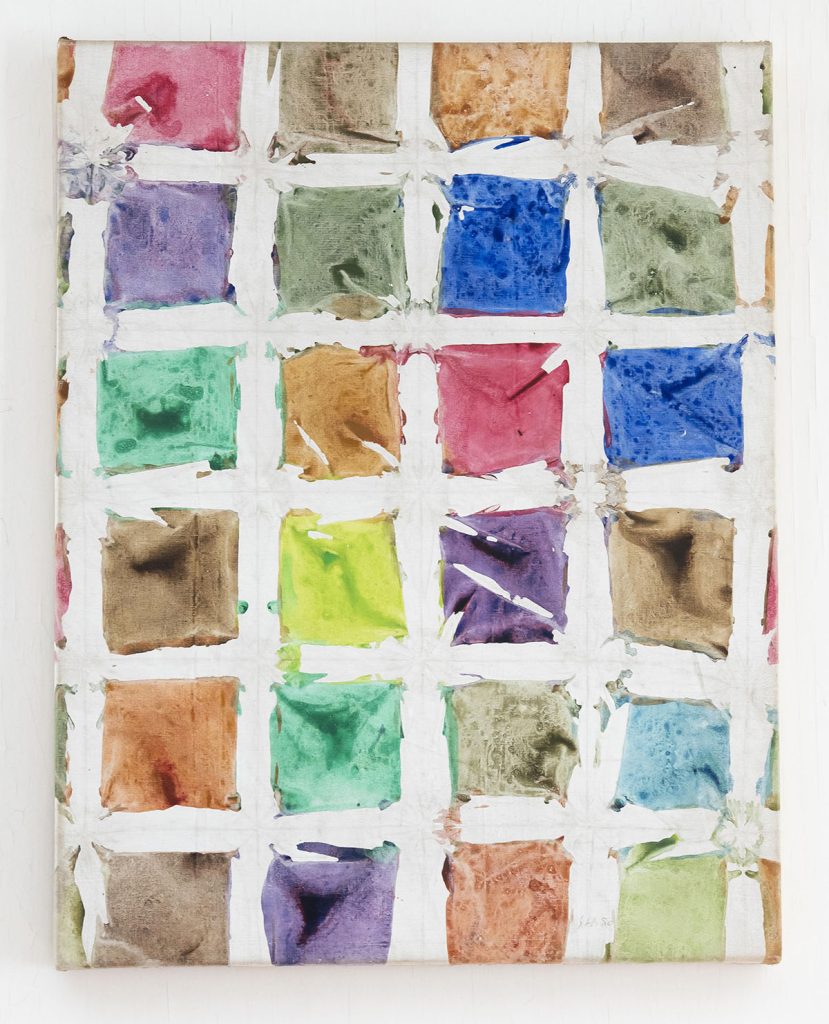
This dynamic continues in the compositions of Simon Hantaï, where folding sculpts the surface of the canvas in an alternation of void and fullness, resonating with the ink saturations of Houston Maludi.
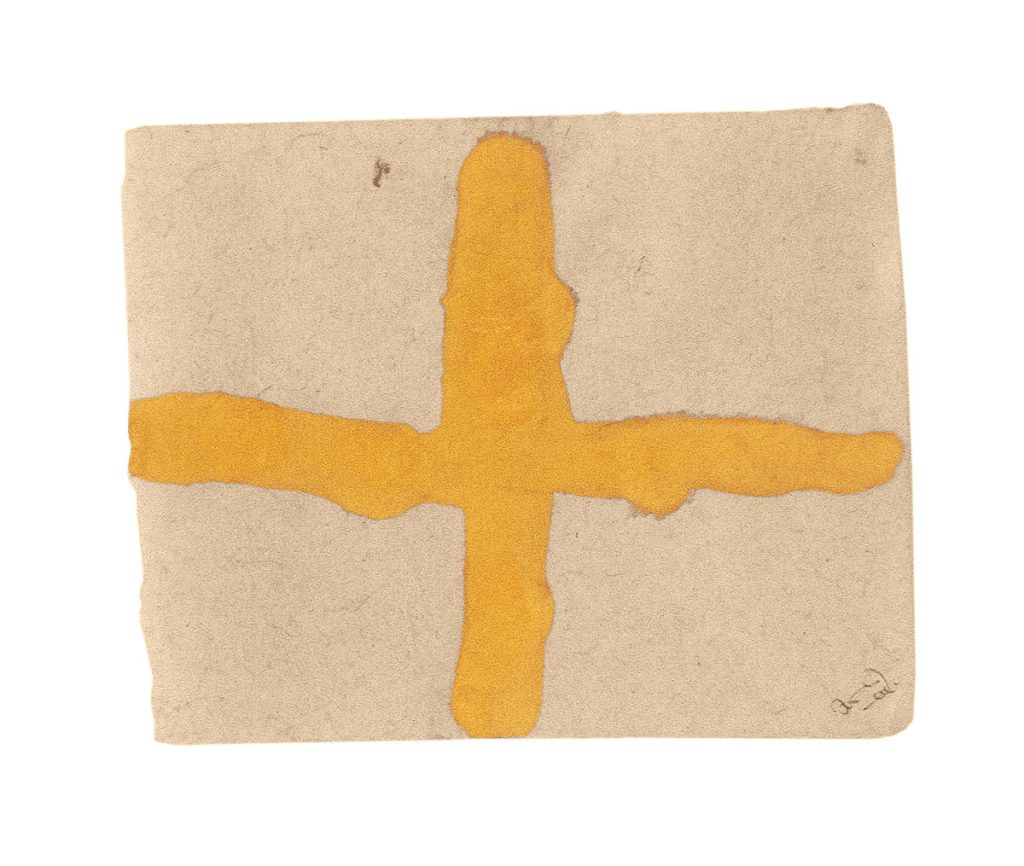
A symbolic convergence crystallizes around the cross, the intersection of the vertical and the horizontal: it appears in Alan Vega’s assemblage as an electric totem, and finds a meditative counterpoint in the paintings of Vyakul, where the ritual form charges the plane with spiritual intensity.
The line condenses further in Man Ray’s small-format work, Vieux Jeu, where the composition freezes dark and precise lines. This economy of means finds a vibratory extension in Henri Michaux’s watercolor, Untitled (circa 1973). Here, the line no longer seeks to delimit but to release appearances: against an evanescent background, threadlike silhouettes and organic signs seem to emerge from an altered state of consciousness. The work perfectly embodies this “adventure of lines” so dear to the artist, where the hand, guided by an inner necessity, allows figures to surface at the edge of abstraction and life. Conversely, in Emanuel Bovet’s work, the trajectory of a bullet crosses the image like a vanishing line that tears through space. Finally, in François Curlet’s work, the horizon line imposes an absolute stability, a definitive boundary that structures the visual field.
From the initial point to the horizon, from the intimate gesture to the monumental construction, the exhibition affirms that the line is not an abstraction detached from the world. It is sensitive writing, tension, rhythm : a way of inhabiting space and revealing the invisible forces that organize our perception.
EXHIBITED ARTISTS :
ANDY WARHOL ★ LOUISE BOURGEOIS ★ ARCHARYA VYAKUL ★ DONALD JUDD ★ ANONYME ★ TANTRA ★ ANTONIO RECALCATI ★ LAJJHO KORWA ★ DANGHI KORWA ★ DHULONG KORWA ★ LAHANGI KORWA ★ ALEXANDER CALDER ★ SIMON HANTAI ★ DIDIER MARCEL ★ EMANUEL BOVET ★ HARMONY KORINE ★ ROBERT WILSON ★ RAFAEL GRAY ★ MARCEL MIRACLE ★ CYPRIEN GAILLARD ★ MONA HATOUM ★ HENRI MICHAUX ★ JONATHAN BOROFSKY ★ LUCIEN HERVÉ ★ MAN RAY ★ BRIGITTE CORNAND ★ GERMAINE KRULL ★ FRANÇOIS CURLET ★ HIRAKU SUZUKI ★ WOLFRAM ★ ADALBERT SCHEFFLER ★ JEAN-MICHEL BASQUIAT ★ CAMERON JAMIE ★ ROBERT ESTERMANN ★ DOUGLAS GORDON ★ TOSHIKATSU ENDO ★ TRACEY EMIN ★ JEAN-MICHEL ALBEROLA ★ CYPRIEN CHABERT ★ CLAUDE CLOSKY ★ VEIT STRATMANN ★ HOUSTON MALUDI ★ AGNES TROUBLÉ ★ EMIL HALMOS ★ VALENTIN RANGER ★ THOMAS HIRSCHHORN ★ BANGER
Nous utilisons des cookies pour optimiser notre site web et notre service.
Functional cookies
Always active
Le stockage ou l’accès technique est strictement nécessaire dans la finalité d’intérêt légitime de permettre l’utilisation d’un service spécifique explicitement demandé par l’abonné ou l’utilisateur, ou dans le seul but d’effectuer la transmission d’une communication sur un réseau de communications électroniques.
Préférences
Le stockage ou l’accès technique est nécessaire dans la finalité d’intérêt légitime de stocker des préférences qui ne sont pas demandées par l’abonné ou l’utilisateur.
Statistics
Le stockage ou l’accès technique qui est utilisé exclusivement à des fins statistiques.Le stockage ou l’accès technique qui est utilisé exclusivement dans des finalités statistiques anonymes. En l’absence d’une assignation à comparaître, d’une conformité volontaire de la part de votre fournisseur d’accès à internet ou d’enregistrements supplémentaires provenant d’une tierce partie, les informations stockées ou extraites à cette seule fin ne peuvent généralement pas être utilisées pour vous identifier.
Marketing
Le stockage ou l’accès technique est nécessaire pour créer des profils d’utilisateurs afin d’envoyer des publicités, ou pour suivre l’utilisateur sur un site web ou sur plusieurs sites web ayant des finalités marketing similaires.






 Learn more